
Game Design
A game for children with Autism Spectrum Disorder designed for engagement and education
Year
2019
Client
Personal Project
Role
UX and Interaction Design
Team
Solo
Scope
UX Strategy and Game design

Background
Autism Spectrum Disorder (ASD) is a developmental condition marked by notable challenges in social interaction and communication. Numerous therapies have been developed to support individuals with autism, with a focus on enhancing social communication, cognition, learning, and physical abilities. Gamification of therapies provides an alternative method for developing and assessing desired behaviors and cognitive skills in a more natural and emergent context.
How Digital games benefit over Analog games?
-
In a society where autistic people are misunderstood and shunned due to their outbursts, digital games may be able to assist them in developing necessary social and communication skills.
-
Many digital games might theoretically induce players to focus more on the game rather than their play partner because they kept the opportunity for face-to-face contact inside their game design (Collaborative Puzzle, KASPAR). This allowed them to concentrate on one thing at a time, which resulted in the children becoming less hyperactive during play.
The Challenge
How might we encourage and help kids with ASD to speak up, understand the environment around them and socialise while having fun?

Design Process
Design Process
The study began by observing and interacting with autistic kids to understand their play pattern, cognitive load levels and their likes and dislikes.

Competitor Analysis
Competitor Analysis
Direct and indirect competitors were sought who could add to autistic people's involvement and learning digitally.

User Study
User Study
I went to non-profit organisations to observe and interact with autistic children and their caregivers. Parents were also interviewed over the phone. I learned a lot about how they struggle to have fun as a result of this. Their interpretation of the game was different, and keeping them focused on one thing was the most difficult task.
Demography
6-7 years kids
Patterns/ Characteristics shown by autistic individuals:
-
Repetition
-
Matching
-
Holistic Face Processing
-
Deliberate incorrect selections
-
Active care giver involvement required
Preferences to Game Interfaces:
-
Characters in the game
-
Game Feedback
Design Considerations:
-
Soft Colors - Color has a significant impact on a person's mood and anxiety level. Warm earth tones, soothing blue hues, and muted colours will relax the user.
-
Minimum Distractions - Provide a tranquil environment in which consumers are only shown relevant content while ignoring unnecessary adornment and surprises.
-
Legible Typography - The use of sans-serif fonts at a size of not less than 16pt allows for legibility for the user.
-
Positive Environment - Reward work completion and encourage improvement in a way that is both efficient and positive for the user.
Ideation
Inspiration
Goats and Tigers, also known as Adu Huli, was originally a popular game, as evidenced by the pattern engraved on the stone flooring of numerous old and ancient temples. On the parapet inside the mahadwara of the Chamundeshwari temple atop Chamundi Betta (hill) in Mysuru, the game pattern may be found.
The game is known as (Huli gatta) in Karnataka and (Puli Joodam or Puli – Meka) in Andhra Pradesh. This game is also utilised for gambling because it requires strategy and intelligence to win, thus many people will lose. One player controls three tigers while the other controls up to 15 goats in this asymmetric game. The tigers are 'hunting' the goats, who are attempting to obstruct the tigers' movements.

Engravings from Chamundeshwari Temple, Mysuru
Concept (Storyline)
The sheep from two neighbouring farms have all escaped. Two dogs are punished for their irresponsibility. Dogs search for sheep and attempt to bring as many as possible to their respective farms. The first dog to return to the farm with more sheeps is awarded.
Characters
Sheep and dog
Ideation


Game Plan
Game Plan
The final game plan was defined by listing out the elements and writing down the rules for the game. The rules for the final concept are confidential.
Desired Outcome
-
The game should encourage players to speak up to play the game.
-
Multiplayer play may help to build on patience to give others their chance as well as develop on social skills.
-
Minimal parent supervision required.
-
Kids will learn and improve on logical thinking.
Visual Design
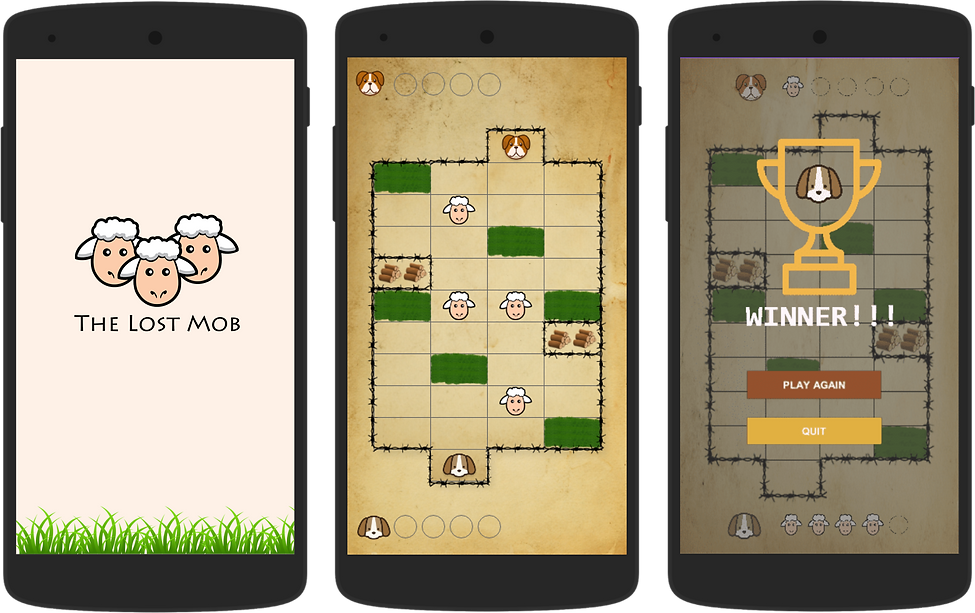
Splash Screen
Game Screen
Winner Screen
Limitation
-
Kids may become more introvert and anti-social.
-
It might be difficult for the kids to build logics at first to win the game. Losing in a row might trigger hyper behaviour of the child.
-
Kids may become addicted to the device.
Future Scope
-
Introducing levels.
-
Making speech prominent in the game.
-
Use of Artificial Intelligence for blocking
-
Developing the game in Virtual Reality environment